
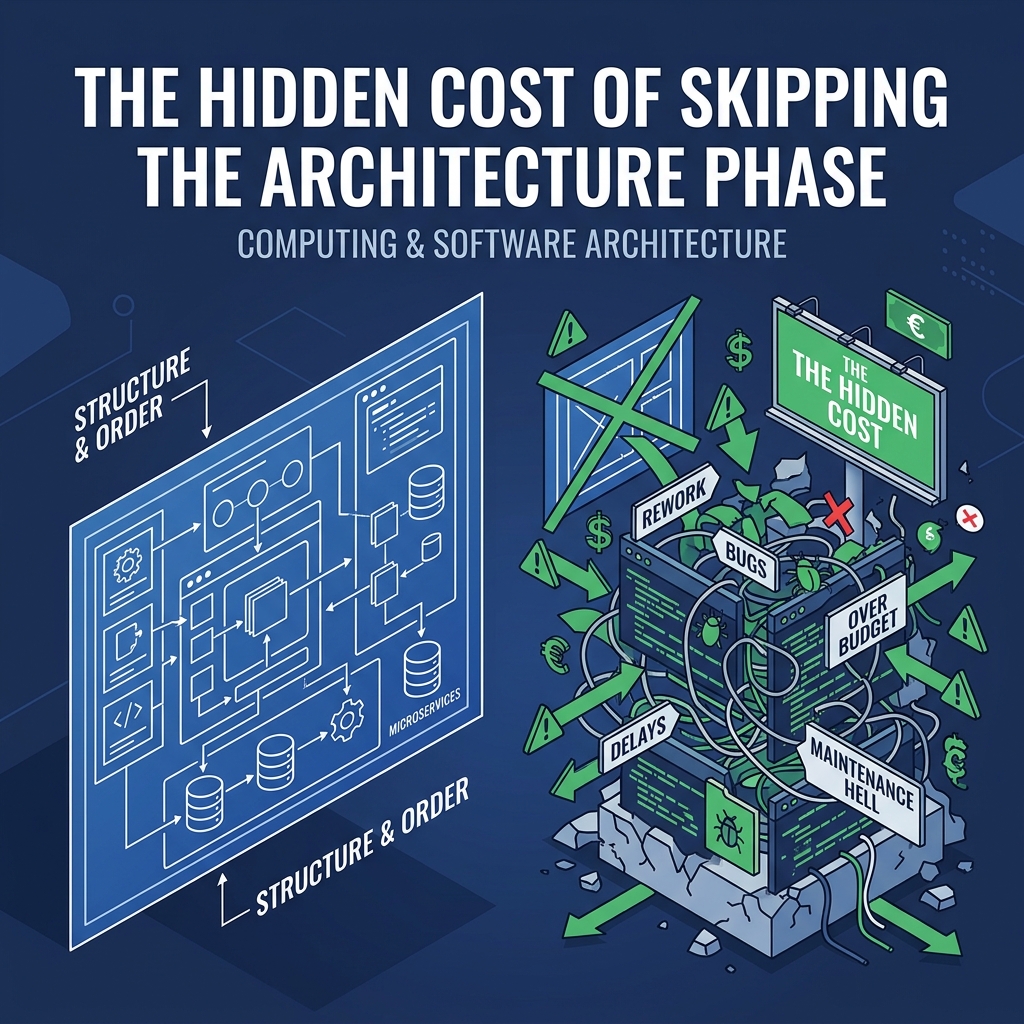
Every week spent on architecture can prevent months of costly rework later. Companies that learn this lesson the hard way often pay twice: once for the original development, and again through rewrites, delays, and missed business opportunities.
The False Economy of Skipping Architecture
The pressure to ship fast is real.
Stakeholders want to see progress. Teams want to start building. Developers want to write code, not spend weeks documenting diagrams and decisions.
So the architecture phase gets compressed into a short whiteboard session, or skipped entirely, and the team moves straight into implementation.
At first, this feels like progress.
Commits are happening. Features are being delivered. The first demo works.
But underneath the surface, important decisions that were never made explicitly are being made implicitly by whoever writes the next function, chooses the next database structure, or integrates the next service.
Those decisions accumulate.
Over time, the result can be a system that becomes increasingly difficult to understand, modify, test, and scale.
The problem is not that the team is moving fast.
The problem is that some of the most expensive decisions in software are being made without enough time to evaluate their long-term consequences.
What the Cost Actually Looks Like
The hidden costs of insufficient architectural planning rarely appear as a single line item on a project budget.
They appear gradually through:
- Features that take significantly longer than expected because the existing data model does not support them cleanly
- Incidents caused by tightly coupled components where a change in one area affects another
- Increasing technical debt and development complexity
- Longer onboarding periods because system logic and architectural decisions are poorly documented
- Rework and migration projects that consume significant engineering capacity without directly creating new business features
For large IT projects, the scale of these problems can be substantial.
A joint study by McKinsey and the University of Oxford analyzed more than 5,400 IT projects. For large IT projects with initial budgets above $15 million, the study found an average 45% cost overrun, 7% schedule overrun, and 56% shortfall in expected benefits.
The research also found significant differences between project types. Large software projects in the dataset averaged 66% over budget and 33% over schedule, with a 17% shortfall in expected benefits.
These figures do not mean that poor architecture alone causes project overruns. Large technology projects fail or underperform for many reasons, including project complexity, requirements, stakeholder alignment, technology choices, team structure, and execution.
But they illustrate why decisions made early in a software project deserve serious attention.
The Right Time to Invest in Architecture
The right time to make fundamental architectural decisions is before implementation begins.
Not because architecture is more important than implementation, but because architectural decisions can become increasingly expensive to change once a system is in production.
Changing a database schema after months of development and production data is very different from choosing an appropriate data model before implementation begins.
Replacing a tightly coupled component after multiple services depend on it is a much larger undertaking than defining clear boundaries between components at the start.
Architecture creates a framework for making these decisions deliberately.
A proper architecture phase for a mid-sized software project should establish the foundations that the development team will work from.
Depending on the project’s complexity, this can include:
- A system context diagram
- Component and service architecture
- Data models and database structures
- API and interface definitions
- Architecture Decision Records (ADRs)
- Security and integration considerations
- Scalability and performance requirements
- Reliability and availability requirements
- Non-functional requirements with measurable acceptance criteria
The objective is not to predict every detail of the future.
The objective is to make the most important structural decisions visible, discussable, and reversible where possible before they become expensive to change.
Architecture Is Not About Drawing Diagrams
Good architecture is not documentation for the sake of documentation.
It is a way of reducing uncertainty before implementation becomes expensive.
An architecture blueprint gives developers a shared understanding of how the system should work. It gives stakeholders a way to review important technical decisions before they are embedded into the product.
It also creates a reference point when the project evolves.
Requirements will change. New integrations will be added. Business priorities will shift.
Good architecture does not attempt to prevent change.
It makes change easier to manage.
What Insimplo Does Differently
At Insimplo, we protect the architecture phase from the pressure to compress it.
Before implementation begins, we develop a documented architecture blueprint that the entire team, including the client, can review, question, and approve.
This creates alignment before significant development effort is committed.
The goal is simple: understand the system before building it.
Our architecture process focuses on the decisions that have the greatest impact on the project’s future:
System structure.
How the major components interact and where responsibilities belong.
Data.
How information is structured, stored, accessed, and transferred.
Interfaces.
How services, applications, and external systems communicate.
Security.
How authentication, authorization, data protection, and other security requirements are addressed.
Scalability.
How the system can respond to increasing users, data, and workloads.
Non-functional requirements.
How performance, reliability, availability, maintainability, and other quality attributes will be measured.
The result is more than a technical document.
It becomes a shared reference for the development process.
The Cost of Architecture vs. the Cost of Rework
Architecture requires time.
But the alternative is not “no cost.”
The alternative is often paying for architectural decisions later, when changing them requires modifying existing code, migrating data, updating integrations, retesting dependent systems, and managing production risk.
That is why architecture should not be viewed simply as an additional phase before development.
It is an investment in reducing uncertainty and controlling the cost of change.
The earlier a critical architectural decision is made, the more options the team usually has.
The later that decision is challenged, the more dependencies may already exist around it.
Build With a Plan
Moving quickly does not necessarily mean starting implementation as soon as possible.
For complex software systems, moving quickly can mean reducing uncertainty before committing significant engineering resources.
Architecture provides that foundation.
It gives the development team a shared technical direction, gives stakeholders visibility into important decisions, and creates a clearer path from requirements to implementation.
At Insimplo, we believe the best software projects do not start with code.
They start with understanding.
Planning a software project? Talk to our team for the right architecture.
Sources
McKinsey & Company and the University of Oxford, Delivering large-scale IT projects on time, on budget, and on value, October 2012. The study reports that large IT projects with initial budgets above $15 million averaged 45% over budget, 7% over schedule, and 56% less value than predicted, based on more than 5,400 IT projects.
McKinsey & Company, Achieving success in large, complex software projects, July 2014. The analysis reports that large software projects averaged 66% over budget and 33% over schedule, with projects experiencing a 17% shortfall in expected benefits.