
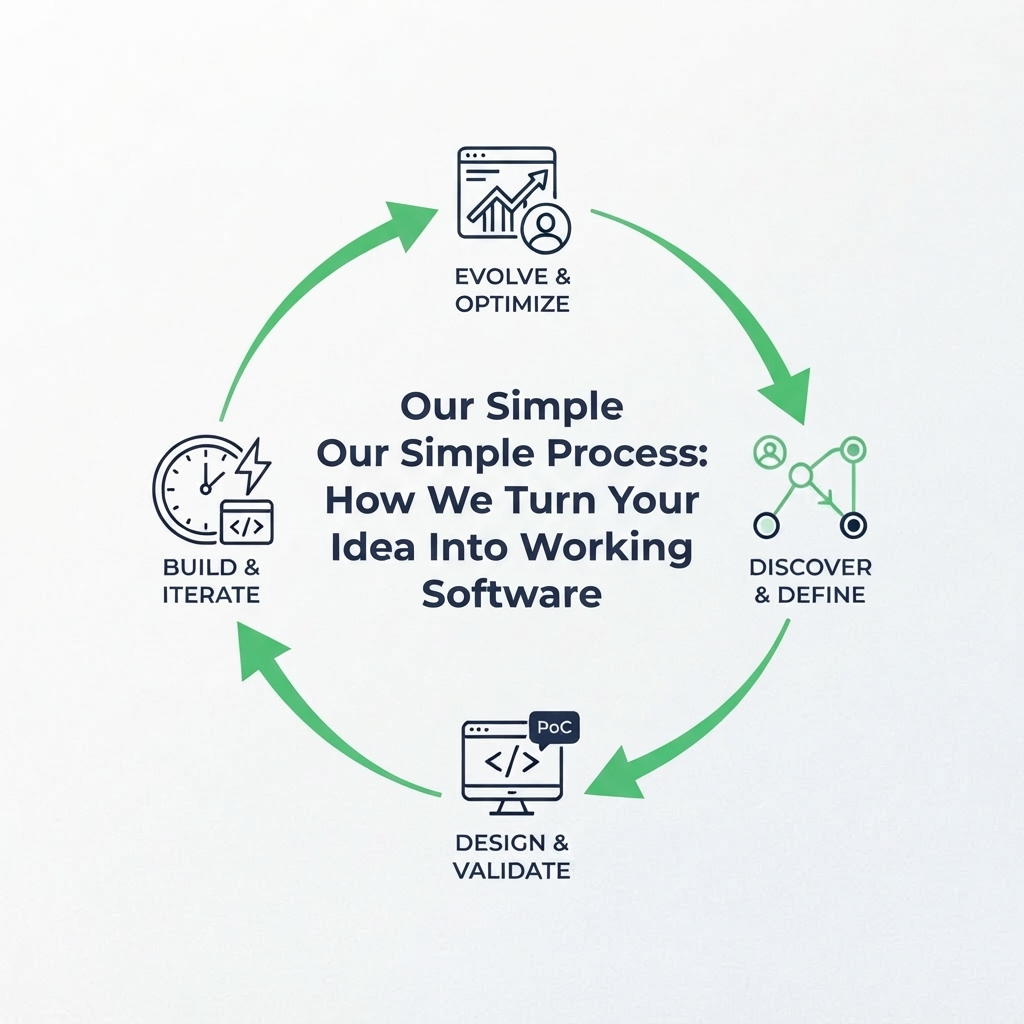
Complex projects fail for simple reasons: unclear goals, hidden assumptions, and too much built before anyone checks whether it works. At Insimplo, we keep our software development process deliberately simple, four clear steps that move you from an idea to reliable software running in production, with no surprises along the way.
Key takeaways
- A simple, four-step process reduces risk and keeps you in control of budget and scope.
- We validate feasibility with a proof of concept before full development begins.
- Short build sprints mean you see working software early and often, not months later.
- We stay after launch to measure, support, and improve.
Step 1: Discovery: define the real problem
Every good build starts with a hard look at the problem. In Discovery, we sit down with your team to define goals, constraints, and, crucially, the metrics that will tell us the project succeeded. We ask uncomfortable questions early, because a misunderstanding caught in week one costs a conversation, while the same misunderstanding caught in month four costs a rebuild.
By the end of Discovery you have a shared, written understanding of what we are building, who it is for, and how we will measure success. If we conclude that AI is not the right answer, and sometimes good engineering is all you need, we tell you honestly. Read more about how we think in how our engineers solve complex problems.
Step 2: Design & Validate: prove it works before you pay to build it
Next, we map the user journeys and design the system architecture. But we do not stop at diagrams. We test feasibility with a proof of concept (PoC), a small, focused build that answers the riskiest question first. Can the model reach the accuracy you need? Will the integration with your existing system hold up? Is the data clean enough?
This is where our Discovery Workshop methodology pays off: we de-risk the expensive parts of a project while the investment is still small.
Step 3: Build & Iterate: working software, early and often
With the risky questions answered, we build in short sprints. Each sprint ends with working software you can actually use, not a status slide. Regular feedback loops mean the product bends toward what your users need as we learn more, instead of arriving all at once at the end and missing the mark.
We apply the same engineering discipline throughout, clean architecture, automated testing, and secure-by-design infrastructure. Security is never bolted on at the end; it is part of every sprint. That is a core part of how we build privacy-first AI.
Step 4: Evolve: we don’t launch and leave
Launch day is a milestone, not the finish line. Real usage produces real data, and real data reveals what to improve next. We support rollout, monitor performance, and continuously optimize using what the system tells us. This is why we don’t “launch and leave”, software that isn’t maintained quietly rots.
Why simple wins
A simple process is not a shallow one. Behind each step sits deep engineering rigor, the simplicity is what keeps you in control. You always know what stage we are in, what we are trying to prove, and what it costs. That clarity is the difference between a project that drifts and one that ships.
Frequently asked questions
How long does each step take?
It depends on scope, but Discovery is typically days to a couple of weeks, and the first working build often lands within the first few sprints. We size each phase with you during Discovery.
What if requirements change mid-project?
They will, and the process is built for it. Short sprints and regular feedback mean we adapt to change instead of resisting it.
Can you work with our existing systems?
Yes. We specialise in integrating AI and new platforms into existing workflows rather than replacing everything at once.
Ready to see the process in action? Start your project with a no-pressure Discovery conversation.